1. Inclusive Decision-Making Platforms
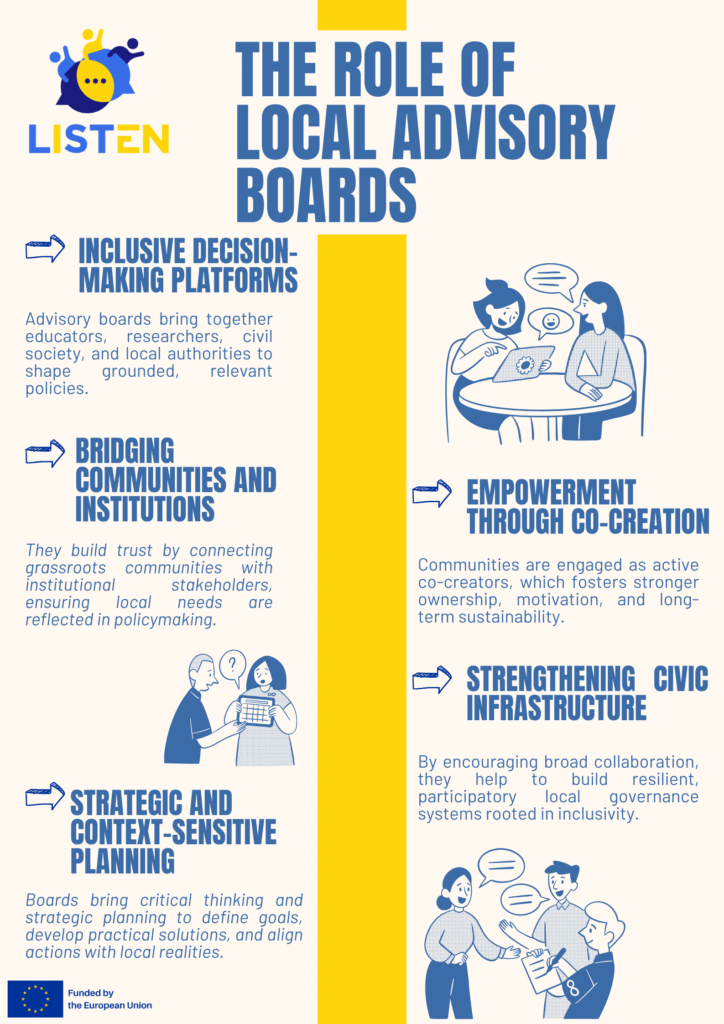
Local advisory boards create spaces where diverse voices—including community members, educators, researchers, civil society actors, and local authorities—can come together to shape policies and initiatives. This collaborative approach ensures that decisions are grounded in the realities of those most affected.
2. Bridging Communities and Institutions
By facilitating dialogue between grassroots communities and institutional stakeholders, the boards help to build trust and ensure that local needs are accurately represented and addressed in policy development.
3. Strategic and Context-Sensitive Planning
Advisory boards bring critical thinking and strategic planning into the process of community engagement. Their insights help define clear goals, identify practical solutions, and ensure that initiatives are feasible and aligned with local contexts.
4. Empowerment Through Co-Creation
Rather than treating communities as passive recipients, the boards empower them to become co-creators. This strengthens ownership, boosts motivation, and enhances the long-term sustainability of outcomes.
5. Adaptability and Responsiveness
Designed to be flexible, the boards can respond to evolving local conditions and needs. Their ability to incorporate ongoing feedback and learn from experience ensures continued relevance and impact.
6. Strengthening Civic Infrastructure
By fostering collaboration among various stakeholders, local advisory boards help to build more resilient, participatory civic ecosystems. They play a key role in nurturing inclusive and democratic local governance.